

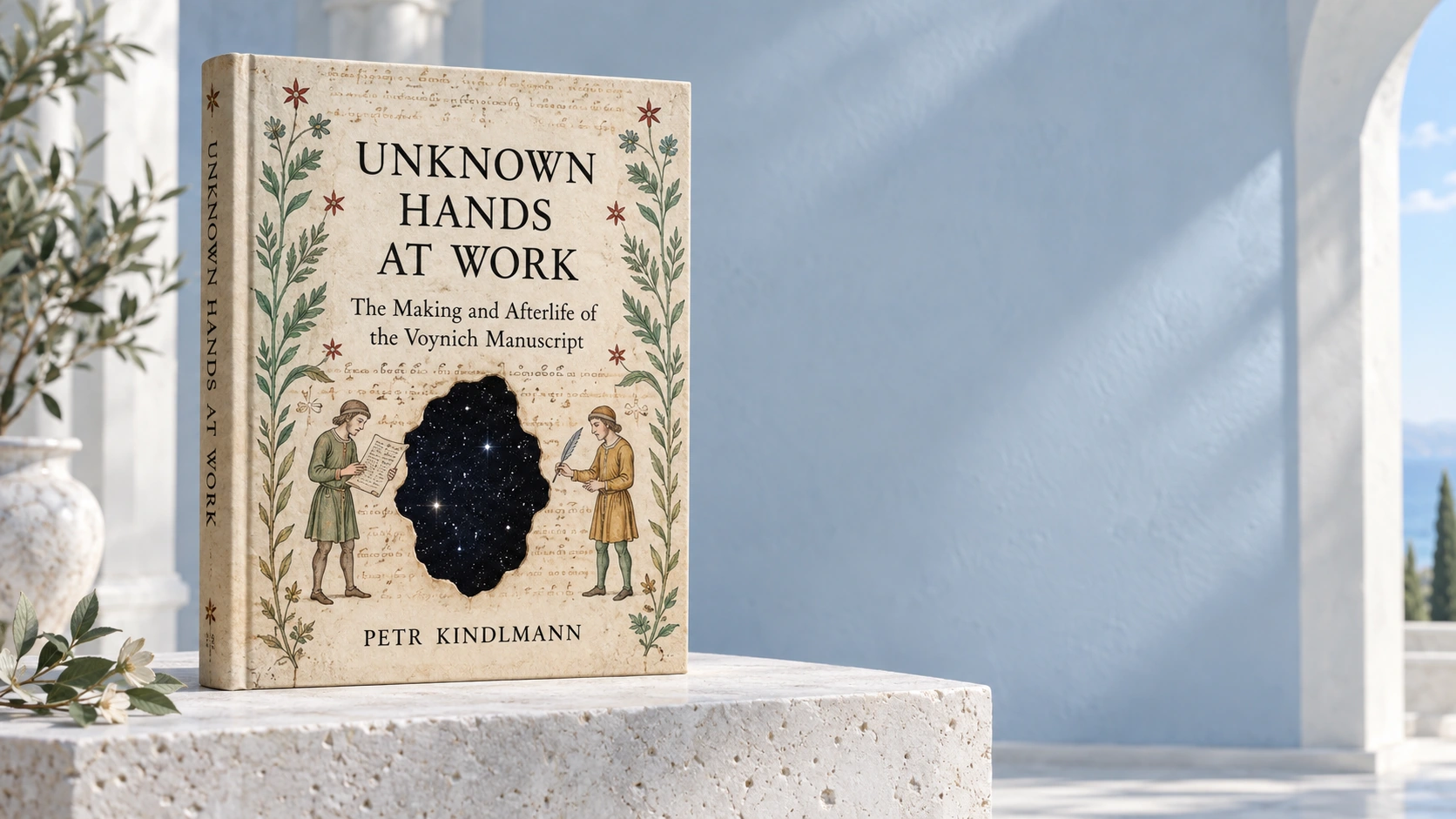
Petr Kindlmann

Unknown
Hands
at Work

The Making and Afterlife
of the Voynich Manuscript

An unread script. A surviving object.
A history we can begin to see.

Begin the journey

A mark. A leaf. A book.

01 / The finished page

A world
on a page.

Plants beside paragraphs. Stars in the margins. Writing that follows a circle.

Folds, drawings and differences between hands let us compare the work, even while the words remain unread.

Explore the chapters

The drawing opens into a paper world.

02 / Making and keeping

A book
among books.

Books were borrowed, copied, inherited, collected and withheld. A copy could travel while a volume stayed behind.

Letters and catalogues bring people into the story.

Meet the readers

Workrooms. Towns. New readers.

03 / Return to the book

The making.
The keeping.
The afterlife.

Follow the evidence from a mark on parchment to the lives of the people who made, handled and kept books.

Choose an exploration

The story continues in the book.

01 / 04 Scroll to explore

The question behind the book

What can we learn
before we can
read the words?

The Voynich Manuscript preserves more than an unfamiliar script. Its parchment was folded, its pages worked on, its volume kept and passed on.

Differences in letter forms help distinguish the work of the scribes. Letters, catalogues and household accounts record how books were bought, lent and copied.

Explore the chapters

Open a chapter. Try the evidence.

Explore the book.

Search a written form. Compare the hands. Follow a sequence of stars. Begin with a detail that catches your eye.

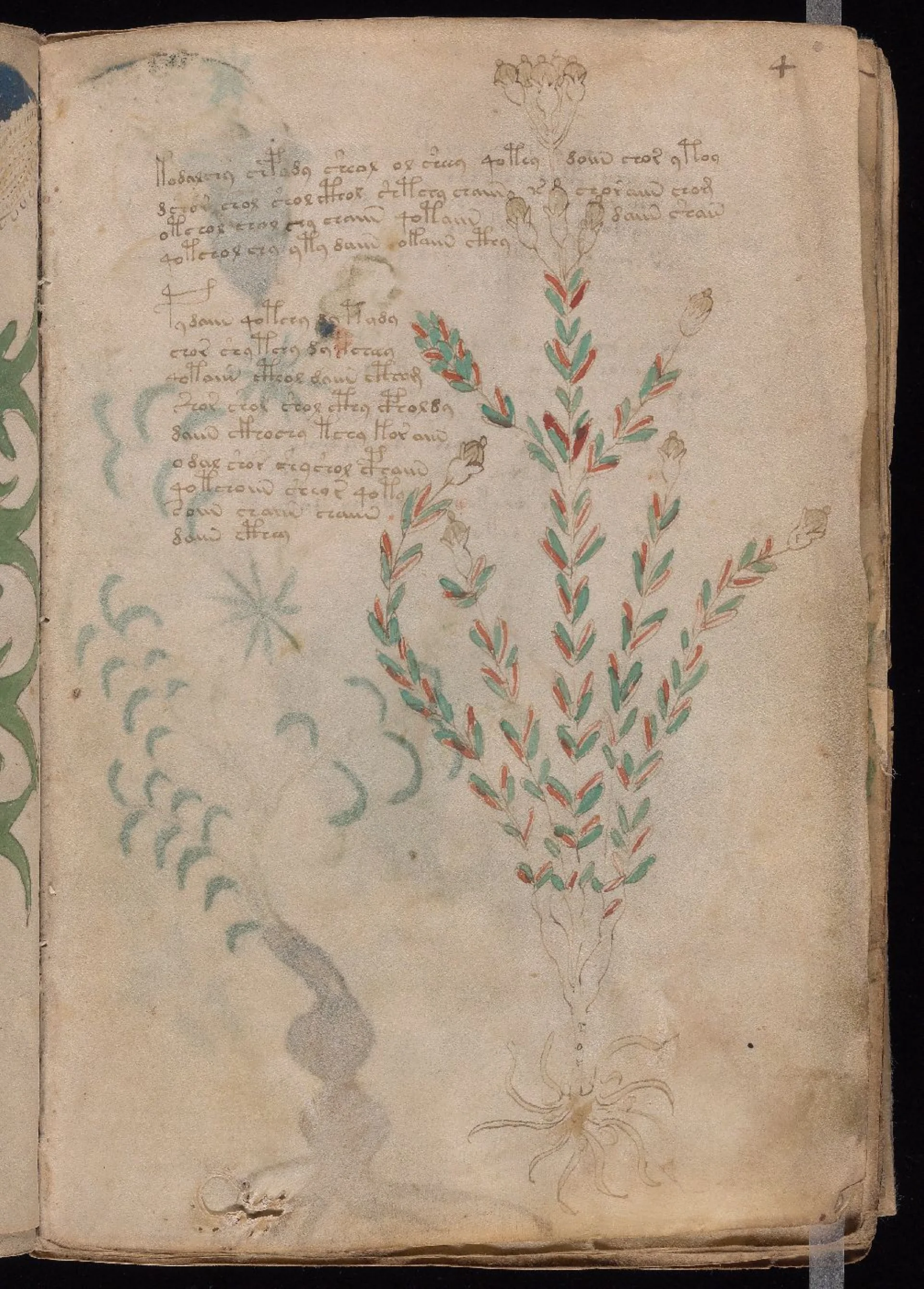
The plant, roots and writing on folio 4r.
Beinecke MS 408 · Folio 4r · Yale University Library

The manuscript / Chapters 1, 5 & 6

A page to look into.

A plant occupies the centre of this page. Writing fills the space around it. The transcription lets us find recurring forms across the volume.

Loading the transcription counts…

EVA represents the written signs with Latin characters and combinations.

Open the manuscript reader
Continue into a detailed exploration, or keep reading the book.Read the opening passage

Inside the book

Sixteen chapters.
Five movements.

From the material object to the historical circumstances around it.

01The Object and Its Makers3 chapters
  1. 01A Skin, Folded
  2. 02Five Hands
  3. 03The Sheet
02The Finished Page4 chapters
  1. 04Which Came First
  2. 05The Plants
  3. 06Circles and Their Labels
  4. 07A Routine in Red
03The Writing3 chapters
  1. 08The Pattern Before the Person
  2. 09The Exceptions
  3. 10Where the Keys Stop
04After the Makers2 chapters
  1. 11Marks Without Names
  2. 12Names Enter the Record
05What History Can Put Around Them4 chapters
  1. 13Where a Book Could Wait
  2. 14What a Book Cost
  3. 15Baths, Households, and Keys
  4. 16A Warning About Books

From the afterlife chapters

A book
among books.

Books were borrowed, copied, inherited, collected and withheld. Letters and catalogues bring people into the story.

What people did with books

Possession, access and understanding are different things. Documents help us see the difference.

A copy could travel.

Marci’s letter of 1665 or 1666 reports that an earlier possessor copied a portion for Kircher while refusing to send the book itself. Marci later presented the volume to the same hoped-for reader.

Chapter 12 · Names Enter the Record

Read the letter’s place in the record
A catalogue kept the differences.

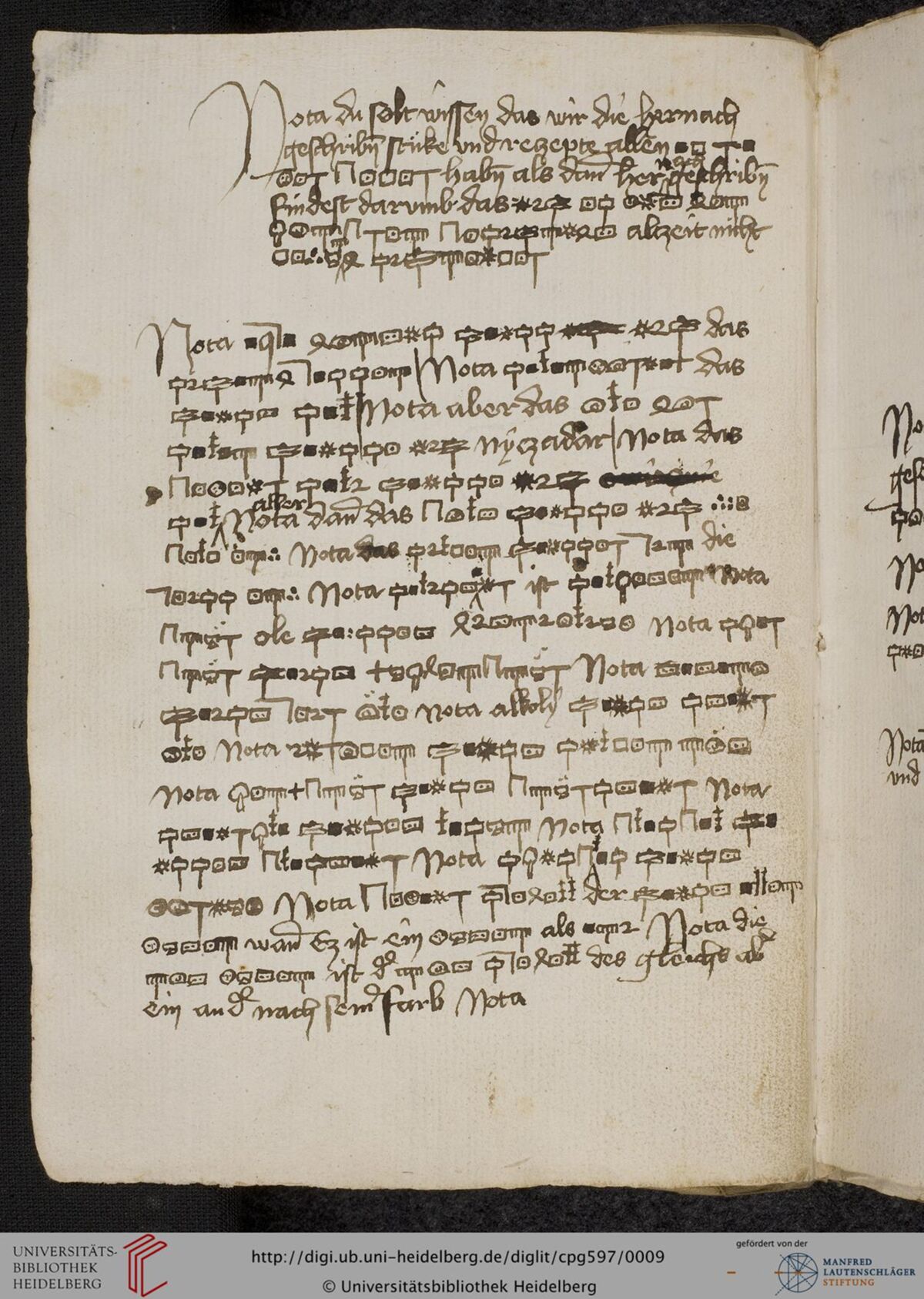
At St. Katharina in Nuremberg, women recorded books brought in, borrowed and given away. One catalogue entry distinguished three earlier histories among the parts of one volume.

Chapter 13 · Where a Book Could Wait

Explore St. Katharina’s catalogue

Work belonged to a household.

Burkard Zink remembered copying while Elisabeth spun beside him, after a former teacher advanced money for paper. His account connects books to marriage, paid work and changing livelihood.

Chapter 15 · Baths, Households, and Keys

Read the household example

From the research behind the chapters

Read further.

Browse the articles

Drawing and handwriting

From Pairwise Similarity to Page-Level Inference: A Cross-Modal Stress Test in the Voynich Manuscript

Read the article

Changes within a page

A Within-Page Stress Test of Text-Based Scribe Classification in the Voynich Manuscript

Read the article

How pictures and labels are arranged

Sign-Local Concordance in the Voynich Zodiac Labels: Distinguishing Sign, Band, and Ordinal Organization in Beinecke MS 408

Read the article

An opening passage

Look at
the edge.

Introduction / 01

An irregular hole opens near the right-hand side of a circular drawing in the Voynich Manuscript. Around it, small human figures stand among stars and short runs of brown writing. Writing is visible above and below the opening, and a curved outline passes to its left. Along the lower edge, a pale rim separates the marked surface from the darkness seen through the opening.

The detail comes from part of the foldout designated folio 72v. Seen in the full photograph, it belongs to a much larger arrangement, with a balance-like drawing at the centre. The figures, stars and writing extend around that centre in successive rings. Some figures face towards the centre; others lie sideways or upside down as the arrangement turns around the page. The hole occupies part of the interval between two rings of figures. Looking more closely returns the eye to the interruption: it can follow the brown signs down towards the hole, then find writing again below it. What happened at this small place is harder to establish than its position in the drawing.

Continue the opening passage

It is tempting to supply a sequence: the opening was already there, and someone fitted the writing around it. That would give the interrupted line a place in the making of the page. Yet the photograph shows the surface as it survives. It cannot establish the earlier shape of the opening, or whether the marks beside it were made before or after it formed. Later damage could also have changed their relation to an edge. Choosing the first story would turn a visible arrangement into an account of a person's response without the evidence needed to connect them.

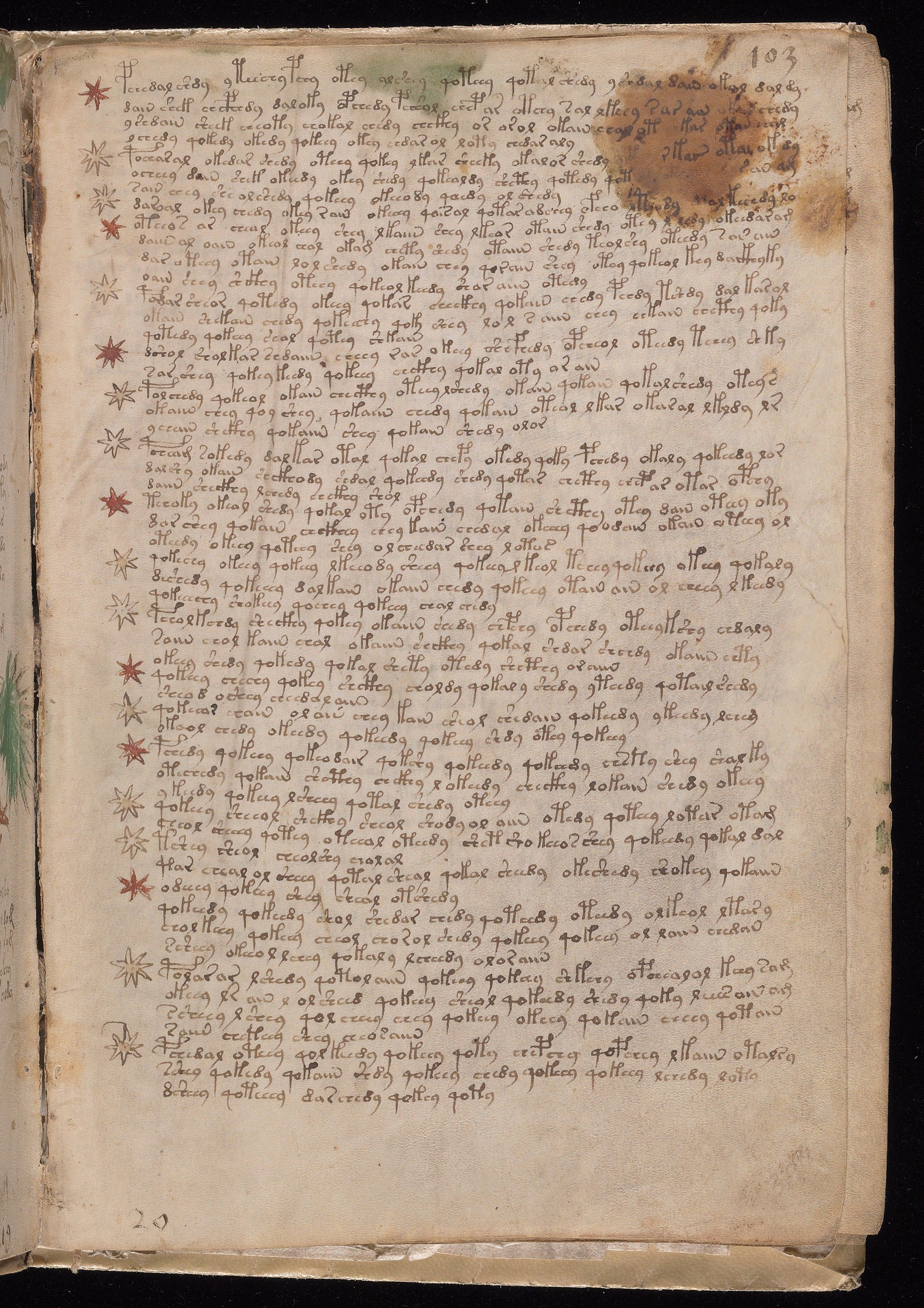
There is still something to examine. The surrounding marks have shapes, intervals and directions. A short run beside a figure and a longer run following a circle occupy different places in the drawing. Elsewhere in the volume, large plants stand beside paragraphs, figures gather within green forms, and red-centred stars alternate with pale ones down the margins. These arrangements offer comparisons before they yield names for the depicted subjects or meanings for the writing. The question is how far those comparisons can take us towards the work of making the book.

A folded sheet gives one answer. Two leaves can lie far apart in the bound volume while remaining parts of the same piece of parchment. If we compare only neighboring pages, we may miss that connection. The shape of a written sign gives another: a crossbar and a loop can differ in construction even while their value is unknown. Lisa Fagin Davis's proposed hand attributions bring such differences together into a map of the manuscript. The people remain unnamed, but the work can be divided and compared more precisely than an impression of one strange script would allow.

From the Introduction. Excerpt ends after the fifth prose paragraph.

The opening detail is folio 72v (part), Beinecke MS 408, Yale digital image 1006205. From the forthcoming book.

A book by Petr Kindlmann

Take the story
with you.

Unknown Hands at Work

The Making and Afterlife
of the Voynich Manuscript

A study of the manuscript’s material structure, writing, drawings and documented afterlife. Illustrated, with chapter notes and references.

16 chaptersEnglishPublication forthcoming

Publication forthcoming. Cover design in development.

The author & the research

Petr Kindlmann

This project brings historical interpretation together with corpus and image analysis. The Explore section brings together the manuscript reader, articles and interactive comparisons.

Selected articles

The surviving surface

Folio 72v, detail

Enlarged original manuscript photograph of the hole on folio 72v, surrounded by brown signs and curved outlines.

Brown writing, stars and curved outlines surround the opening in the parchment.

View the source at Yale

The surviving manuscript

Folio 4r · Plants

The complete photograph of folio 4r.

A large painted plant stands among paragraphs of writing. The relationship between drawing and text is one of the questions explored in the book.

Beinecke Rare Book and Manuscript Library, Yale University · MS 408

The surviving manuscript

The Rosettes foldout

The full Rosettes foldout, folios 85v–86r.

Folios 85v–86r. Connected circular forms extend across a sheet much wider than an ordinary page.

Beinecke Rare Book and Manuscript Library, Yale University · MS 408

The surviving manuscript

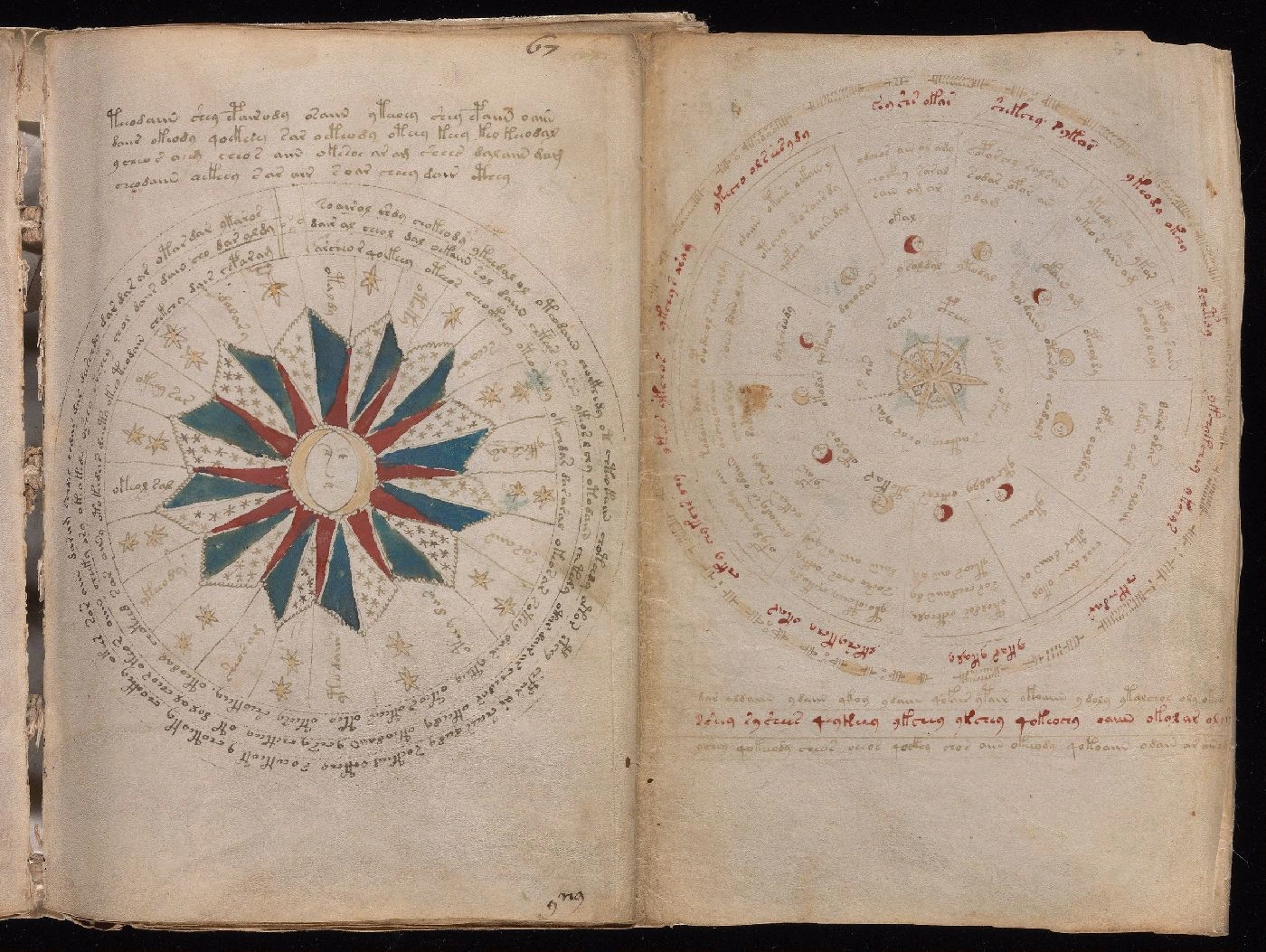
Folio 67r · Circles

Source photograph of folio 67r, showing both circular diagrams.

The gallery isolates the red and blue circular diagram on the left. This photograph retains the rest of the page and its surrounding writing.

Beinecke Rare Book and Manuscript Library, Yale University · MS 408

The surviving manuscript

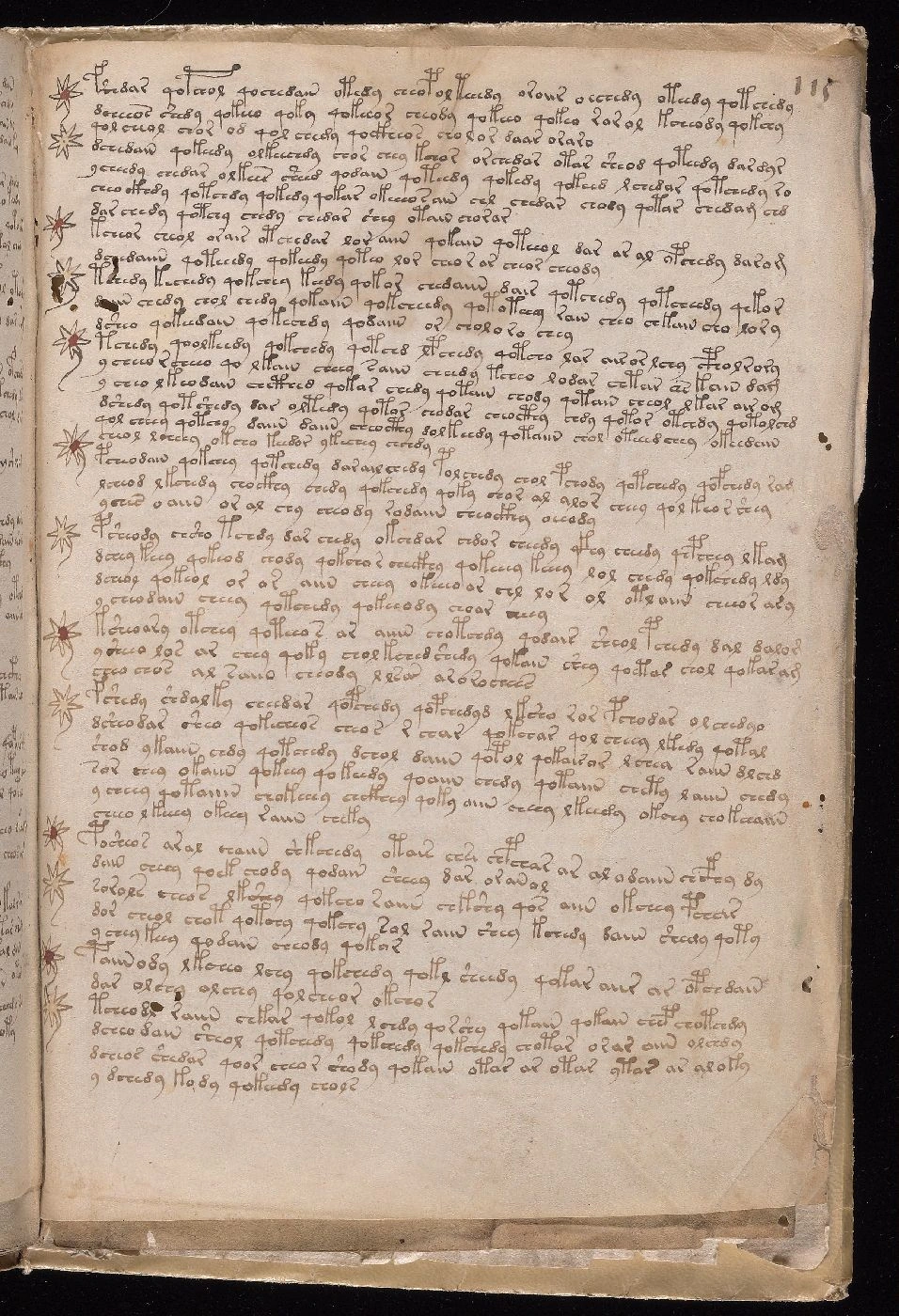
Folio 115r · Writing

Full source photograph of folio 115r, with brown writing and stars in the margin.

The gallery enlarges a short passage near the top of this page. The source photograph shows its place within the longer runs of writing.

Beinecke Rare Book and Manuscript Library, Yale University · MS 408

Three proposals · none final

Cover studies

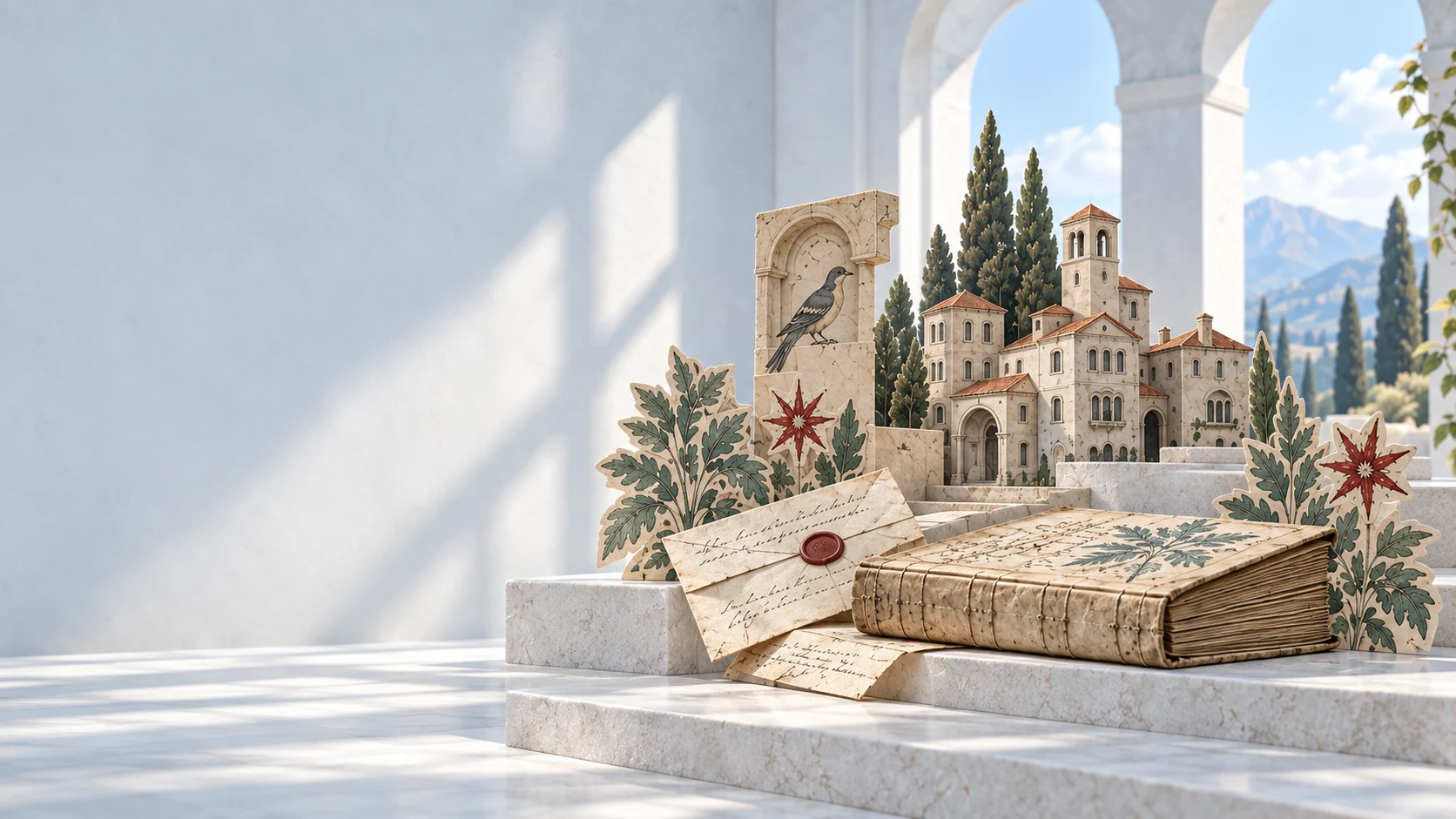
Gallery cover with the revised artisan figures, the second direction.
2 · Gallery. Revised figures: one handling a manuscript leaf, one holding a quill.
Download this study Earlier figures in the gallery proposal ↗